


A collaborative research group consisting of Instructor Kei Sato of the GS Education Program, Institute of Liberal Arts and Science, Kanazawa University; Associate Professor Robert Jenkins of the School of Geosciences and Civil Engineering, Institute of Science and Engineering, Kanazawa University; Researcher Shinnosuke Teruya of the Coastal Branch of Natural History Museum and Institute, Chiba; and Assistant Professor Moe Kato of the Kyushu University Museum (at the time of the research: Specially Appointed Assistant Professor, Institute for Promotion of Diversity and Inclusion, Kanazawa University) has documented in detail the coastal biota exposed on land along the rocky shores of the Soto-ura region of the Noto Peninsula as a result of the 2024 Noto Peninsula Earthquake (M7.6), which caused one of the largest coastal uplift events recorded in Japan.
In the area around Kaiso Fishing Port in the northwestern Noto Peninsula, the earthquake caused a dramatic vertical uplift of approximately 3.6–3.9 meters. This rapid topographic change exposed biological communities in the subtidal zone (*), which normally can only be accessed through diving surveys, onto land in the same arrangement as when they were alive. The research group began field surveys as early as 66 days after the earthquake and succeeded in reconstructing, with unprecedented accuracy, the rich ecosystem structure that had existed prior to the earthquake by conducting a detailed analysis of the benthic organism death assemblages around Kaiso Fishing Port.
This study is a globally valuable report that documents the impact of a sudden geological event on coastal ecosystems in the unique semi-enclosed waters of the Japan Sea. The findings from this study are expected to be used as basic data for monitoring the post-disaster ecosystem recovery process, which is expected to progress simultaneously with global warming in the future.
The results of this research were published in the online edition of "Plankton and Benthos Research", a joint journal of the Plankton Society of Japan and the Benthos Society of Japan, on February 26, 2026.

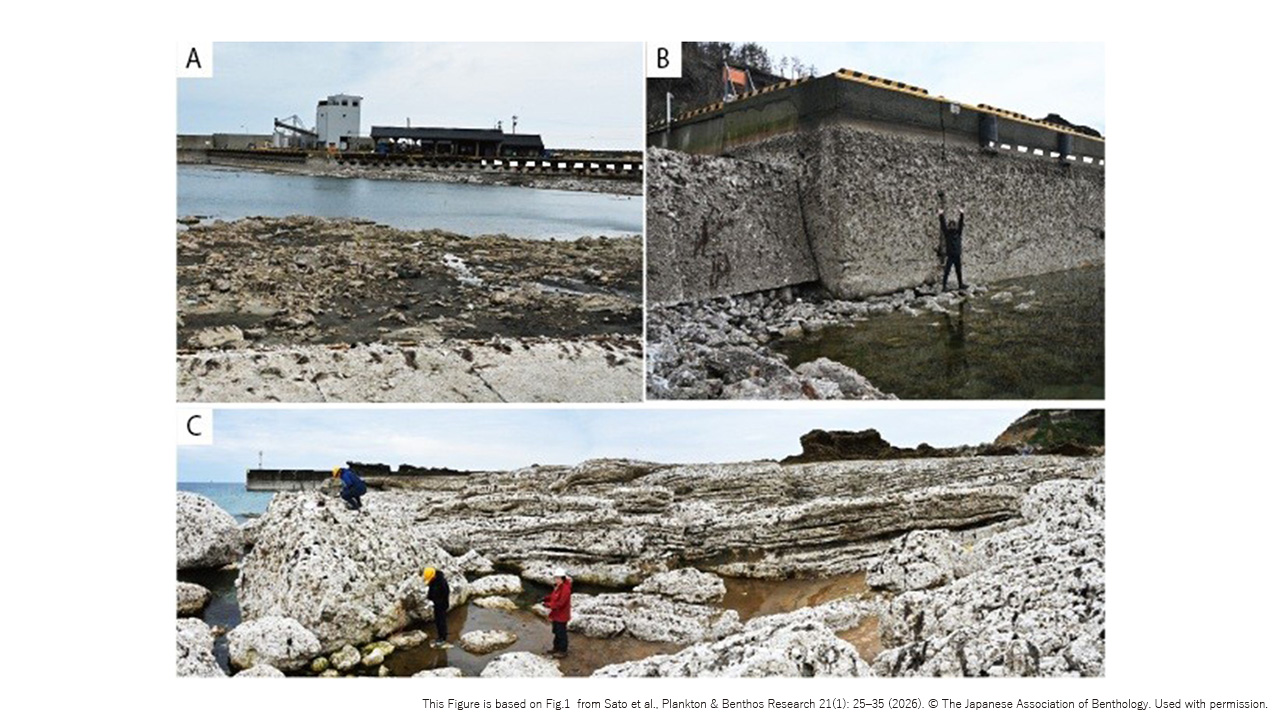
Figure: Overview of the study site
(A, B) The dried-up Kaiso Fishing Port after the earthquake. Numerous sessile bivalves (Japanese oysters) and polychaete tubes were found on the quay wall, and pen-shell and Oulastrea crispata (a colonial coral) were observed on the exposed seafloor. (C) Scene from the survey conducted on the rocky reef south of the fishing port (Kaiso Fishing Port). The entire reef surface appears white because it is covered with bleached seaweed (Pilihiba).
A, C: photographed on April 21, 2024; B: photographed on March 21, 2024.
This Figure is based on Fig.1 from Sato et al., Plankton & Benthos Research 21(1): 25–35 (2026).
? The Japanese Association of Benthology. Used with permission.
【Glossary】
* Subtidal zone
An area that remains below the sea surface even at the lowest tide and is always submerged. A notable feature of this earthquake is that even this zone—normally never exposed on land—was uplifted and dried for several meters.
Click here to see the press release【Japanese only】
Journal : Plankton and Benthos Research
Researcher Information : Kei Sato
Jenkins, Robert
Related Information
School of Geosciences and Civil Engineering, College of Science and Engineering, Kanazawa University : https://www.se.kanazawa-u.ac.jp/geoandcivil
Graduate School of Natural Science and Technology, Kanazawa University : https://www.nst.kanazawa-u.ac.jp/eng/
 PAGE TOP